


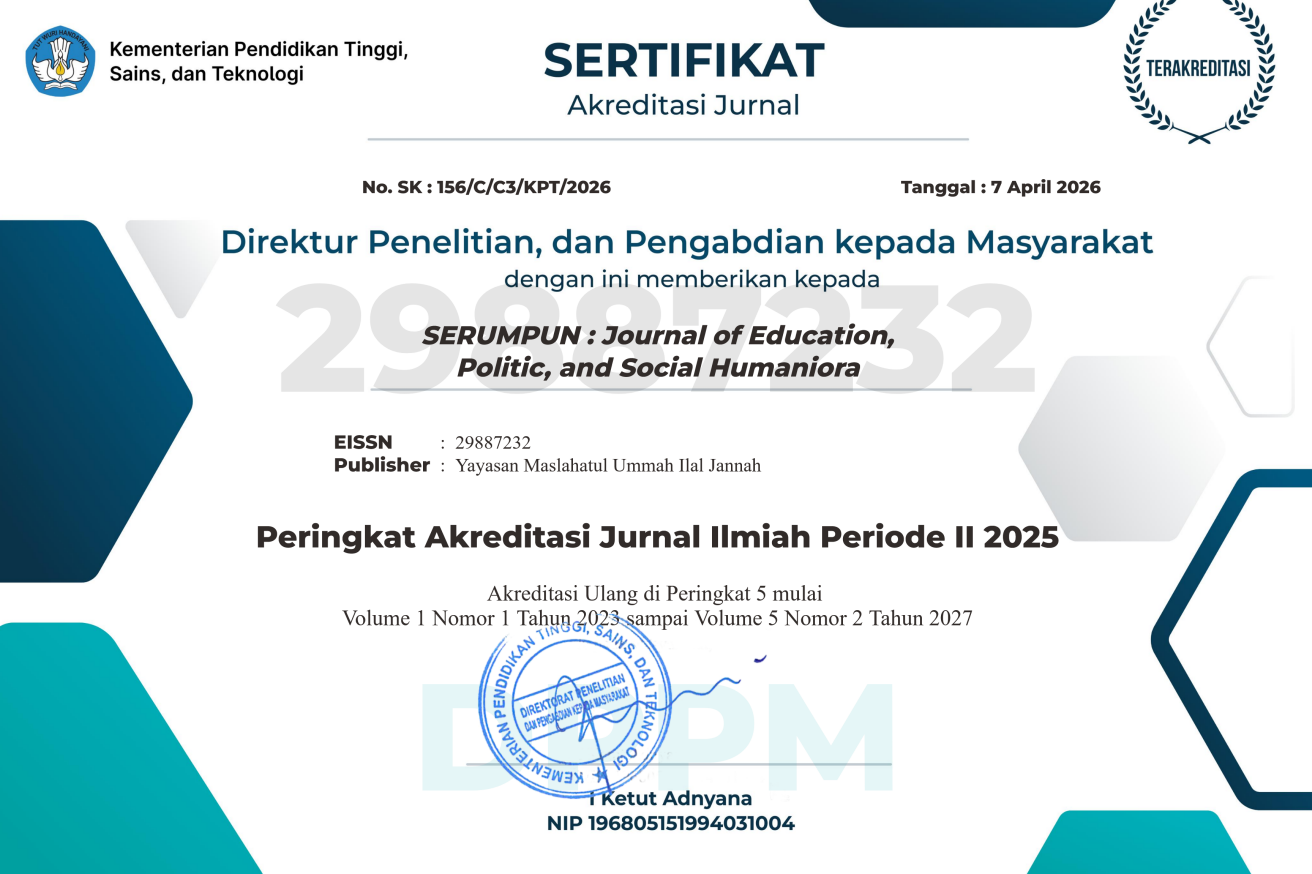


_(2)_(1)_(1).png)
- Focus and Scope
- Section Policies
- Peer Review Process
- Open Access Policy
- Publication Ethics
- Plagiarism Policy
- Publication Frequency
Focus and Scope
Serumpun: Journal of Education, Politic and Social Humaniora is a peer-reviewed national journal published biannually (June and December) by Yayasan Maslahatul Ummah Ilal Jannah, South Kalimantan, Indonesia. This journal serves as a platform for academic discussion and critical studies in the fields of Education, Politics, and Social Humanities.
The journal welcomes original, research-based articles that have not been published or are not currently under review by other journals. It encourages contributions from scholars, researchers, and students who are engaged in scientific inquiry and interdisciplinary research within the following scopes:
Education: Teaching and learning methodologies, curriculum development, educational policy, teacher training, and innovations in education.
Politics: Political theory, governance, public policy, political behavior, democracy, and political institutions, especially those related to Indonesian and global contexts.
Social Humanities: Cultural studies, sociology, anthropology, ethics, philosophy, and other humanistic approaches to social issues.
All submissions undergo a rigorous review process involving the editorial board and blind peer reviewers to ensure high academic standards and relevance.
Section Policies
Articles
 Open Submissions Open Submissions |
Indexed |
Peer Reviewed |
Peer Review Process
All manuscripts submitted to Serumpun: Journal of Education, Politic and Social Humaniora undergo a single-blind peer review process to ensure the quality and integrity of scholarly publishing.
Initial Screening
The editorial team conducts a preliminary evaluation to ensure the manuscript fits the journal's focus and scope, meets basic quality standards, and complies with submission guidelines. Manuscripts that do not meet these criteria will be returned to the authors without further review.Single-Blind Review
Eligible manuscripts are forwarded to at least two independent reviewers who are experts in the relevant field. Both the reviewer and the author identities are kept anonymous to maintain objectivity. Reviewers evaluate the manuscript based on originality, methodological rigor, clarity of presentation, relevance, and contribution to the field.Review Outcomes
Reviewers may recommend one of the following:
Accepted without revisions
Accepted with minor revisions
Accepted with major revisions (re-review required)
Rejected
Revision and Resubmission
If revisions are required, authors will be given a deadline to revise their manuscript based on the reviewers’ comments. The revised manuscript may be sent back to the original reviewers for further evaluation, depending on the extent of the changes.Final Decision
The final decision to accept or reject the manuscript lies with the Editor-in-Chief, based on the reviewers’ recommendations and the quality of the revision.Publication
Accepted manuscripts are copyedited, typeset, and scheduled for publication in the upcoming issue.
The journal is committed to maintaining the highest ethical standards and follows best practices in scholarly publishing.
Open Access Policy
This journal provides immediate open access to its content on the principle that making research freely available to the public supports a greater global exchange of knowledge.
Publication Ethics
SERUMPUN : Journal of Education, Politic, and Social Humaniora ( E-ISSN: 2988-7232 ) is peer-reviewed National journal published biannually by Yayasan Maslahatul Ummah Ilal Jannah South Kalimantan. The focus discussion of the journal is highlighting aspects Education, politic and Social Humaniora. The journal is published biannually in June and December. This journal publishes the results of research related to focuses on critical studies of Education, Politic and Social Humaniora. Articles should be original, research-based, unpublished and not under review for possible publication in other journals. All submitted papers are subject to review of the editors, editorial board, and blind reviewers.
Serumpun : Journal Of Education, Politic and Social Humaniora invites scholars, researchers, and students to contribute the result of their studies and researches in the areas related to scientific research.
AUTHORS
Reporting Standard
Authors must present the original manuscript, not published in any form, and do not submit the same article to other journals until the publisher give an answer regarding the feasibility of the manuscript. Authors should provide accurate and accountable research data. Authors must cite the sources appropriately by considering the content of the manuscript either in the form of written publications and personal interviews.
Originality dan plagiarism
The authors should ensure that they have written entirely original works, and if the authors have used the work and/or words of others that this has been appropriately cited or quoted.
Multiple, Redundant, or Concurrent Publication
An author should not in general publish manuscripts describing essentially the same research in more than one journal or primary publication. Submitting the same manuscript to more than one journal concurrently constitutes unethical publishing behaviour and is unacceptable.
Authorship of the Paper
Authorship should be limited to those who have made a significant contribution to the conception, design, execution, or interpretation of the reported research. All those who have made significant contributions should be listed as co-authors. Where there are others who have participated in certain substantive aspects of the research project, they should be acknowledged or listed as contributors. The corresponding author should ensure that all appropriate co-authors and no inappropriate co-authors are included on the paper, and that all co-authors have seen and approved the final version of the paper and have agreed to its submission for publication.
Data Access and Retention
Authors may be asked to provide the raw data in connection with a paper for editorial review, and should in any event be prepared to retain such data for a reasonable time after publication.
Disclosure and Conflicts of Interest
All authors should disclose in their manuscript any financial or other substantive conflict of interest that might be construed to influence the results or interpretation of their manuscript. All sources of financial support for the project should be disclosed.
Fundamental errors in published works
When an author discovers a significant error or inaccuracy in his/her own published work, it is the author's obligation to promptly notify the journal editor or publisher and cooperate with the editor to retract or correct the paper. If the editor or the publisher learns from a third party that a published work contains a significant error, it is the obligation of the author to promptly retract or correct the paper or provide evidence to the editor of the correctness of the original paper.
EDITORS
The editor of the Serumpun journal is responsible for deciding which of the articles should be published. The validation of the work in question and its importance to researchers and readers must always drive such decisions. The editors may be guided by the policies of the journal's editorial board and constrained by such legal requirements as shall then be in force regarding libel, copyright infringement and plagiarism. The editors may confer with other editors or reviewers in making this decision.
Fair Play
An editor at any time evaluates manuscripts for their intellectual content without regard to race, gender, sexual orientation, religious belief, ethnic origin, citizenship, or political philosophy of the authors.
Confidentiality
The editors and any editorial staff must not disclose any information about a submitted manuscript to anyone other than the corresponding author, reviewers, potential reviewers, other editorial advisers, and the publisher, as appropriate.
Disclosure and Conflicts of Interest
Unpublished materials disclosed in a submitted manuscript must not be used in editors' own research without the express written consent of the author.
REVIEWERS
Contribution to Editorial Decisions
Peer review assists the editor in making editorial decisions and through the editorial communications with the author may also assist the author in improving the quality of a paper.
Promptness
Any selected referee who feels unqualified to review the research reported in a manuscript or knows that its prompt review will be impossible should notify the editors and excuse himself from the review process.
Confidentiality
Any manuscripts received for review must be treated as confidential documents. They must not be shown to, or discussed with others except as authorized by the editor.
Standards of Objectivity
Reviews should be conducted objectively. Personal criticism of the author is inappropriate. The reviewers should express their views clearly with supporting rationale arguments.
Acknowledgement of Sources
Reviewers should identify the source of references that has not been cited by the authors. Any statement that an observation, derivation, or argument had been previously reported should be accompanied by the relevant citation. A reviewer should also call to the editor's attention any substantial similarity or overlap between the manuscript under consideration and any other published paper of which they have personal knowledge.
Disclosure and Conflict of Interest
Privileged information or ideas obtained through peer review must be kept confidential and not used for personal advantage. Reviewers should not consider manuscripts in which they have conflicts of interest resulting from competitive, collaborative, or other relationships with any of the authors or institutions connected to the papers.
PUBLISHER
It is committed to ensure that commercial interest has no impact or influence on editorial decisions. Serumpun will assist in communications with other journals where this is useful to the authors. Serumpun is working closely with all related divisions to set standards for best practices on ethical matters, errors and retractions--and are prepared to provide specialized legal review and counsel if necessary
Plagiarism Policy
Serumpun: Journal of Education, Politic and Social Humaniora is committed to publishing original works. All submitted articles must be the author’s own work and should not copy from other sources without proper citation.
To maintain academic honesty, the journal checks all submitted manuscripts using plagiarism detection software. The following points apply:
Originality
All articles must be original and have not been published before or submitted to other journals at the same time.Plagiarism Limit
If the similarity score is more than 25%, the manuscript will be sent back to the author for revision or may be rejected.Proper Citation
Authors must clearly cite all sources used in their work. Copying text, ideas, or data from other authors without credit is considered plagiarism.Action on Plagiarism
If plagiarism is found, the article will be rejected.
If the article has already been published, it will be withdrawn from the journal.
By submitting a manuscript, authors agree to follow this plagiarism policy.
Publication Frequency
Serumpun: Journal of Education, Politic and Social Humaniora is published twice a year, in June and December.
Each issue includes original research articles within the scope of education, politics, and social humanities.





Jl. Norman Umar No. 117 Rt. 7 Kelurahan Kebun Sari Kecamatan Amuntai Tengah Kabupaten Hulu Sungai Utara Kode Pos 71415. Email: jurnal.serumpun2022@gmail.com

This work is licensed under a Creative Commons Attribution 4.0 International License.